The 15-Minute Total Body Burn is a compact,Here’s your paragraph with the link added naturally:
Upper Body Toning Without Weights focuses on using your own body weight to sculpt and strengthen your arms, shoulders, chest, and back. Through controlled movements and time-based intervals, this routine improves muscle definition, posture, and upper body endurance—no equipment required.
How short circuits work and the evidence summary
Short, high-intensity interval and circuit workouts can improve cardiorespiratory fitness and metabolic markers while using less total time than traditional steady cardio. Meta-analyses and reviews show interval training raises VO₂max and can improve body composition when repeated consistently. Use progressive overload (more rounds, slower eccentrics, reduced rest) to keep gains coming.
Format choices:
- Intense option: 40 seconds work, 20 seconds rest, 10 exercises (one set = 10 minutes), repeat for 15 minutes by doing 1 full round plus a 5-minute finisher OR do two shorter rounds with lower rest.
- Moderate option: 30 seconds work, 30 seconds rest, 6 exercises, repeat 2 times (total ≈ 12 minutes plus warm up/cooldown to make 15).

Warm up (90 seconds)
- March in place 20s
- Arm circles 10 forward, 10 backward
- Hip hinges / bodyweight good mornings 10s
- Bodyweight half squats 10 reps
Intense 15-Minute Template (higher calorie burn, more cardio)
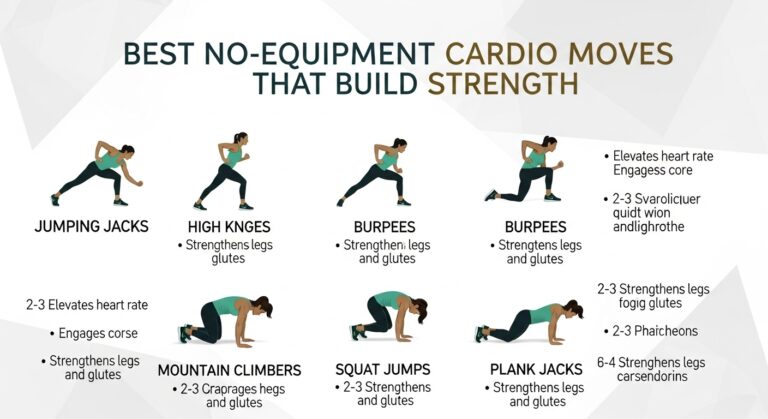
- Jumping jack or step jack — 40s work, 20s rest
- Bodyweight squat (fast tempo) — 40s / 20s
- Push-up or incline push-up — 40s / 20s
- Mountain climbers — 40s / 20s
- Reverse lunge alternating — 40s / 20s
- Plank shoulder taps — 40s / 20s
- Skater or lateral step — 40s / 20s
- Glute bridge (single or double) — 40s / 20s
- Burpee or squat thrust — 40s / 20s
- High knees or march in place (active recovery) — 40s / 20s
Option for 15 minutes: perform first 6 exercises (6 × 1 min = 6 minutes), repeat the 6 (total 12 min), finish with a 3-minute finisher of alternating jumping jack / march sequences, or do one full 10-exercise round and a tailored 5-minute finisher of core or low-impact moves.
Moderate 15-Minute Template (joint friendly)
Work 30s, rest 30s, 6 moves, repeat twice:
- Step jack (low impact)
- Slow tempo squat to reach
- Knee push-up or incline push-up
- Standing knee-to-elbow (core)
- Reverse lunge (stationary)
- Glute bridge or bridge march
Finish with 60s cooldown.
Cooldown (90 seconds)
- Standing hamstring reach 30s
- Chest opener (hands behind back) 30s
- Deep breathing and shoulder rolls 30s

Exercise cues and quick modifications
- Squat: sit back, chest up, heels planted. Modify: box or chair squat. Progression: tempo or jump squat.
- Push-up: neutral spine, lower chest near floor, push through palms. Modify: incline or knees. Progression: declined feet push-up.
- Lunge: long step, front knee tracks 2nd toe, torso upright. Modify: shallow range or static split.
- Mountain climber: keep hips low, driving knee toward chest. Modify: slow plank knee-ins.
- Burpee: control descent and landing; low-impact option is step back + stand (no jump).
Progressions and programming
- Weeks 1–2: 3 sessions per week, start moderate template, focus on form.
- Weeks 3–4: 3–4 sessions, shift to intense template once per week, add one extra round or reduce rest by 10 seconds.
- Progression methods: increase work time, add rounds, slow eccentrics, switch to unilateral variants, or shorten rest intervals.
- For balanced fitness, pair 2 weekly strength sessions with 2 cardio/circuit sessions. Evidence supports time-efficient interval work for improving fitness when part of a consistent routine.

4-Week Sample Plan
| Week | Sessions / week | Session focus |
|---|---|---|
| 1 | 3 | Moderate template ×3, form + mobility |
| 2 | 3 | Moderate ×2, short intense session ×1 |
| 3 | 4 | Intense ×2, Moderate ×2 |
| 4 | 4 | Intense ×2 (shorter rest), Moderate ×2 |
Data-driven calorie guide (MET method, 15-minute examples)
Use METs and the Compendium to estimate energy cost, then apply the standard formula:
kcal/min = (MET × 3.5 × weight(kg)) ÷ 200. Use MET ≈ 5 for moderate circuit work, MET ≈ 8 for vigorous interval circuits. Compendium provides MET definitions and values.
Estimated calories burned for a 15-minute session (approximate)
| Body weight (lb) | Moderate (MET 5) — 15 min | Vigorous (MET 8) — 15 min |
|---|---|---|
| 125 | 74 kcal | 119 kcal |
| 155 | 92 kcal | 148 kcal |
| 185 | 110 kcal | 176 kcal |
These calculations use the formula above and sample METs; actual burn varies by exact intensity, rest structure, age, sex, and fitness. Harvard Health and public MET tables give context for circuit training energy costs.
Common mistakes and fixes
- Mistake: Rushing reps and losing form. Fix: slow tempo and fewer high-quality reps.
- Mistake: Skipping warm up. Fix: add 60–90s joint activation to lower injury risk.
- Mistake: High impact on hard surfaces. Fix: wear shoes, soften landings, or use low-impact options.
- Mistake: Expecting large changes from single sessions. Fix: prioritize consistency and progressive overload.
Safety & special considerations
- People with cardiovascular disease, uncontrolled hypertension, or other serious conditions should consult a clinician before trying vigorous intervals. Monitor RPE or heart rate and stop if you experience dizziness, chest pain, or severe breathlessness. Use low-impact regressions for joint issues.