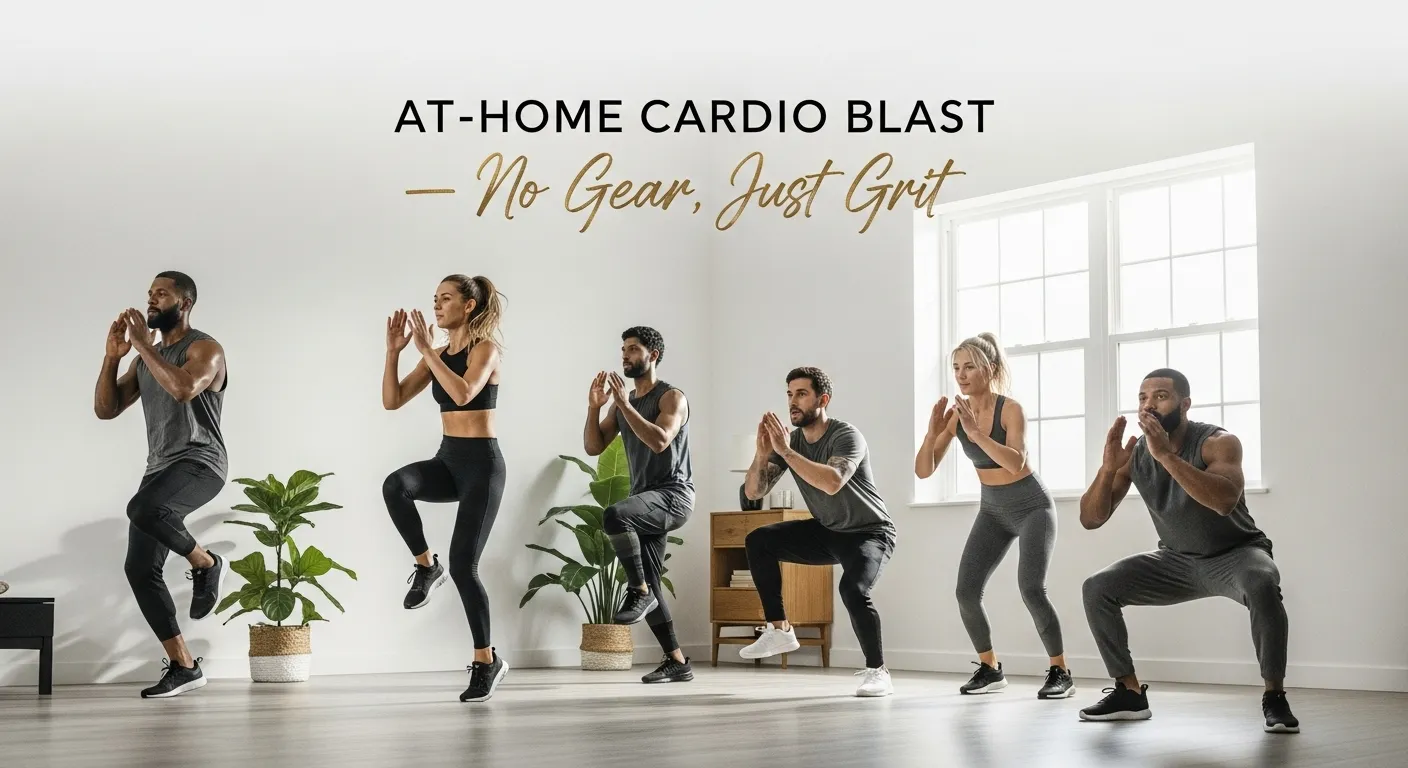
An At-Home Cardio Blast is a short, equipment-free interval session that combines dynamic,Here’s your paragraph with the link added naturally:
The 10-Minute Strength Circuit for Busy Evenings is designed to build muscle and relieve stress after a long day. This quick, no-equipment routine combines compound moves that target major muscle groups, helping you stay consistent and strong even on your busiest nights.

Benefits of an At-Home Cardio Blast
- Time efficient: meaningful stimulus in 10–20 minutes.
- Improves aerobic fitness and metabolic health when repeated consistently.
- Flexible intensity: pick low-impact options for joints or jump variations for higher burn.
- No equipment, minimal space, easy to do at home or in short office breaks.
How short cardio sessions work (brief science)
Short interval and circuit formats alternate high effort with recovery to tax both anaerobic and aerobic systems. Meta-analyses show time-efficient interval training can raise VO2max and improve cardiorespiratory markers, especially when repeated over weeks. For larger VO2max gains, longer intervals and more volume produce bigger effects, but brief blasts still deliver measurable benefits for busy people.
Workout templates
Format key: work : rest. Choose low-impact or high-impact versions. Total time excludes warm-up and cooldown.
Beginner 10-Minute Blast (30 seconds : 30 seconds)
- March in place with arm swings, 30s
- Chair-supported squat, 30s
- Standing knee-to-elbow (slow), 30s
- Step-back lunge alternating, 30s
- Side leg lifts alternating, 30s
- Standing heel kicks, 30s
- Arm circles + small pulses, 30s
- Slow standing march recovery, 30s
Repeat once if you want 20 minutes total.
Standard 15-Minute Blast (40 seconds : 20 seconds) — total 15 minutes
- Jumping jacks or step jacks, 40s
- Bodyweight squat to reach, 40s
- Mountain climbers (slow or regular), 40s
- Reverse lunges alternating, 40s
- High knees or marching high, 40s
- Plank shoulder taps (hands elevated if needed), 40s
- Skater bounds or lateral step, 40s
- Burpee or squat-thrust, 40s
Repeat cycle once for 30 minutes or stop after one cycle for a just-right 15-minute blast.
Exercises, cues, and low-impact options
- Jumping jack: land softly; low-impact option: step jack.
- Mountain climber: keep hips stable; low-impact option: slow plank knee-ins.
- Burpee: control the descent; low-impact option: step back + step up (no jump).
- Skater: land on soft bent knee; low-impact option: lateral step with reach.
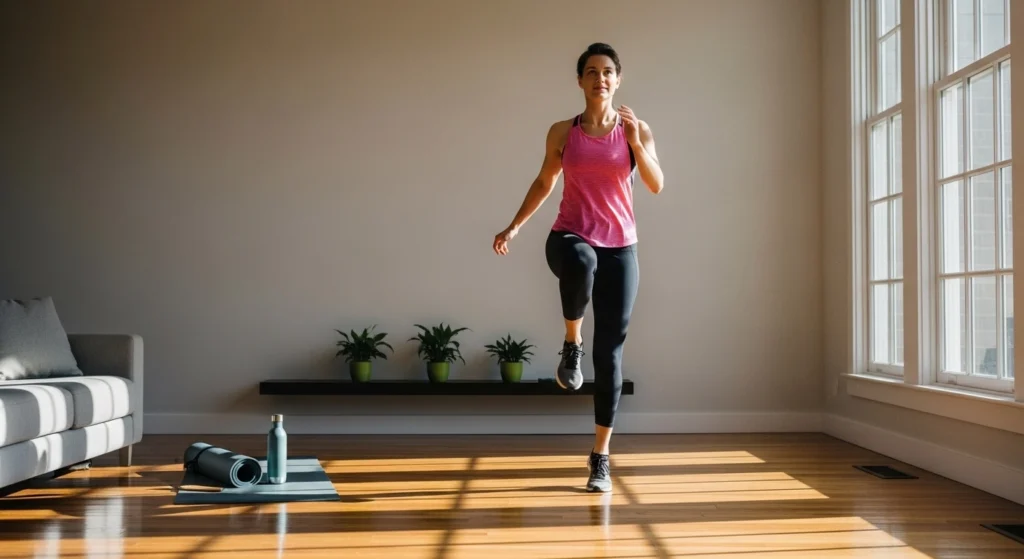
- High knees: drive through hip flexors; low-impact option: marching high.
- Plank shoulder tap: square hips, core braced; modification: hands on elevated surface.
Progressions and programming
- Frequency: 3 sessions per week for maintenance, 4–5 for faster gains.
- Progression ladder: increase work time, shorten rest, add rounds, or swap to higher-impact variations.
- Combine cardio blasts with 2 weekly sessions of strength training for balanced fitness.
Data-driven calorie guide (MET method and examples)
MET (metabolic equivalent) values let you estimate calorie burn. Use this formula:
kcal per minute = (MET × 3.5 × weight in kg) ÷ 200.
Example calculation for a 10-minute vigorous session at MET 8 for a 155 lb person (70.3 kg):
3.5 × 70.3 = 246.05
MET × that = 8 × 246.05 = 1,968.40
Divide by 200 gives kcal/min = 9.842
Times 10 minutes = 98.4 kcal
Estimated calorie burn for a 10-minute session (moderate MET 4, vigorous MET 8)
| Body weight (lb) | Moderate (MET 4) kcal ≈ 10 min | Vigorous (MET 8) kcal ≈ 10 min |
|---|---|---|
| 125 | 39.7 kcal | 79.4 kcal |
| 155 | 49.2 kcal | 98.4 kcal |
| 185 | 58.7 kcal | 117.5 kcal |
Notes: MET values for calisthenics and dynamic bodyweight work vary by intensity; the Compendium lists moderate and vigorous calisthenics in different ranges. Use the table as an approximation. For 30-minute comparisons, Harvard Health tables provide ballpark calorie numbers for common activities.
Common mistakes and how to avoid them
- Moving too fast and losing form: slow down, prioritize full range.
- Neglecting warm-up or cooldown: do 60–90 seconds of joint prep and gentle stretch after.
- Overdoing impact on hard surfaces: wear shoes and soften landings.
- Expecting dramatic results from one session: consistency plus diet and recovery determine long-term change.
Pros and cons
Pros: fast, flexible, scalable, no equipment, suits time-crunched schedules.
Cons: higher-impact options can stress joints, may not replace dedicated strength training for muscle gain, requires basic movement competency to be safe.
Safety notes
- If you have heart disease, uncontrolled blood pressure, or other serious conditions consult a clinician before starting intense cardio.
- Use low-impact options if joint pain or balance issues exist.
- Monitor perceived exertion (RPE) or heart rate; stop if you feel dizziness, chest pain, or severe shortness of breath.