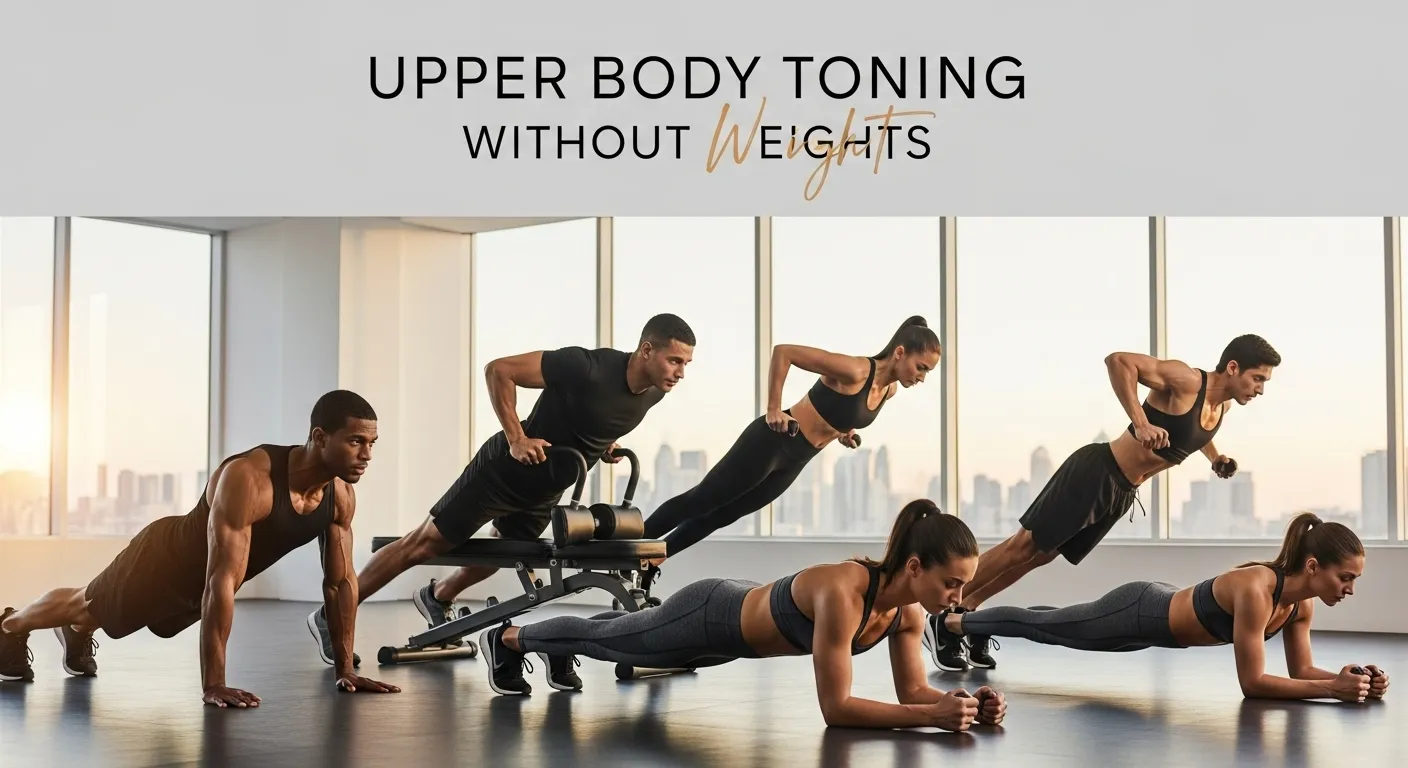
Upper body toning without weights uses push variations,Here’s your paragraph with the link added naturally:
The 15-Minute Total Body Burn is a fast, no-equipment workout that challenges every major muscle group while boosting your heart rate. This routine combines strength, cardio, and core training into one efficient session—perfect for busy days when you want maximum results in minimal time.
Why Upper Body Toning Without Weights Work
- Targets multiple muscles at once, improving efficiency and functional strength.
- Emphasizes progressive overload through tempo, reps, and unilateral work rather than external load.
- Supports posture by balancing chest and upper back strength, which can reduce neck and shoulder tension.
- Fits busy schedules, travel, and small spaces, increasing long term adherence.
Quick warm up (90 seconds)
- Arm circles, 10 forward, 10 backward
- Shoulder blade squeezes, 10 reps
- Scapular push ups, 8 to 10 reps
- Gentle torso rotations, 10 each side
No-Equipment Upper Body Routine, ready to copy
Format: 40 seconds work, 20 seconds rest, 2 rounds for a 12 minute session. Adjust work time and rounds for your level.
- Incline or Knee Push Ups, 40 seconds
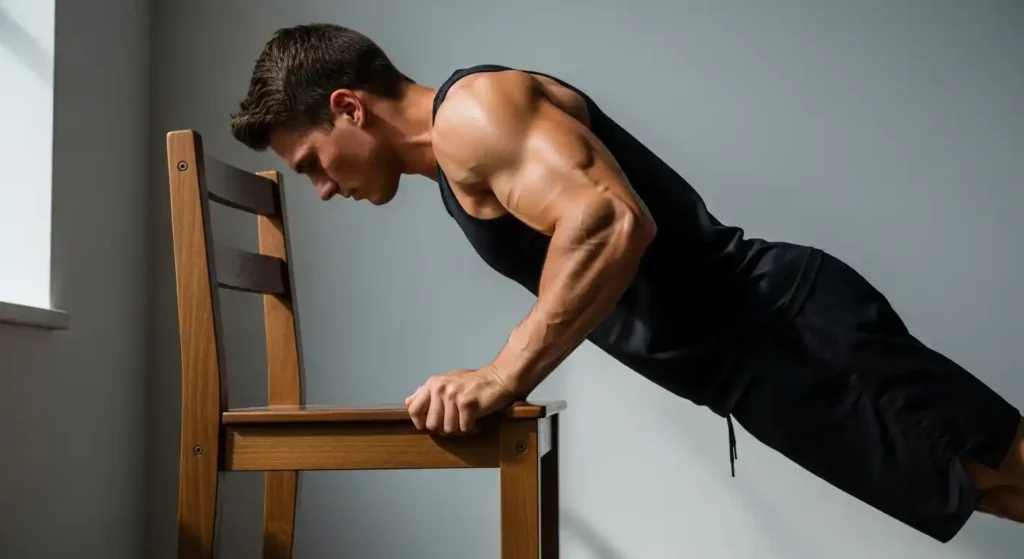
Cues: hands under shoulders, core braced, lower chest to near the surface, push through palms to full elbow extension. Beginner: incline against a counter. Advanced: slow 3 second descent. - Triceps Chair Dip, 40 seconds
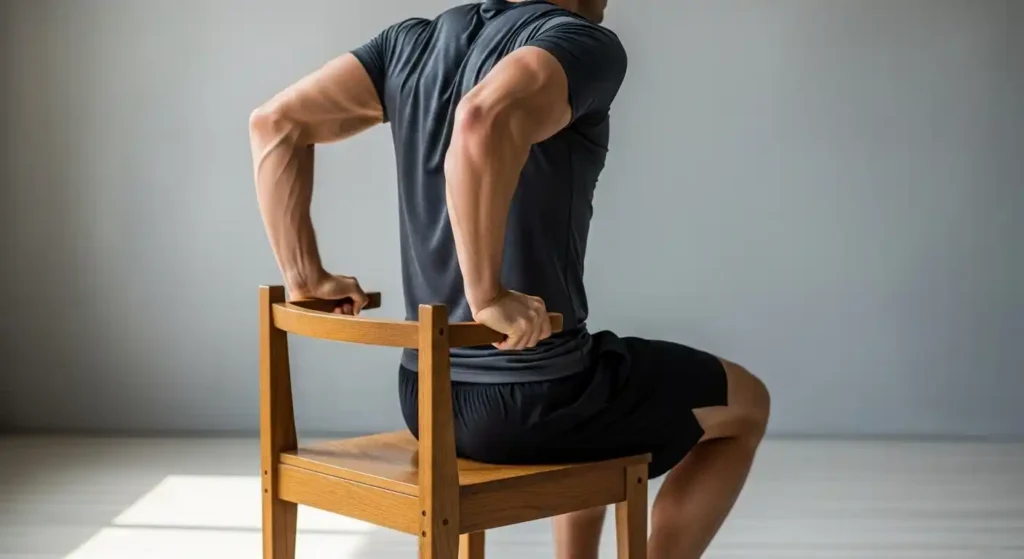
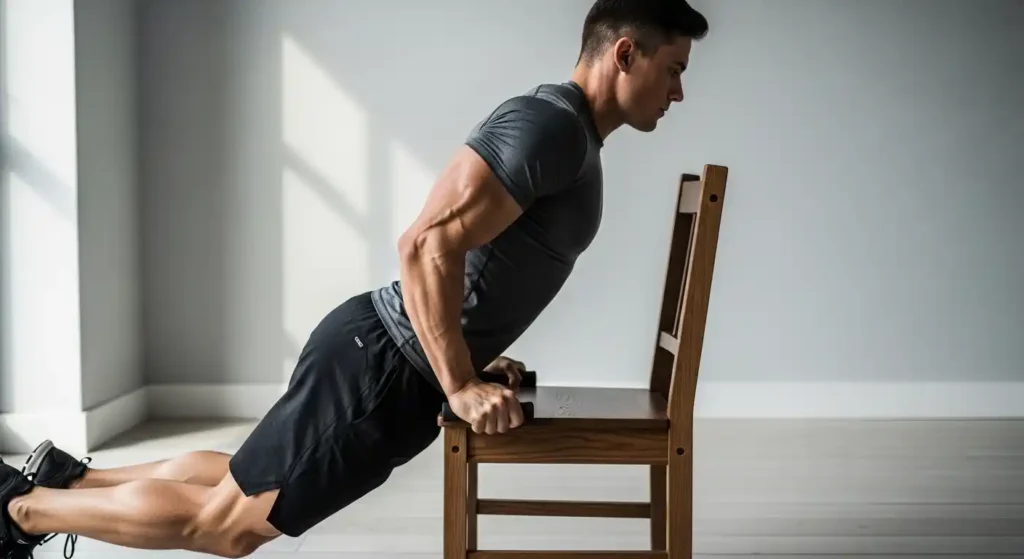
Cues: shoulders down away from ears, elbows track back, avoid dropping hips too low. Beginner: small range of motion. Advanced: single leg extended. - Pike or Elevated Pike Press, 40 seconds
Cues: fold at hips, aim to press through shoulders while keeping neck neutral. Beginner: partial range, Advanced: deeper pike or short holds at the bottom. - Plank Shoulder Tap, 40 seconds
Cues: square hips, tap opposite shoulder slowly to avoid rocking, keep core tight. Modification: knees down. - Reverse Snow Angel on Floor, 40 seconds
Cues: lie face down, lift chest slightly, sweep arms overhead and back to hips with control, keep neck long. This strengthens upper back and posterior shoulder. - Isometric Wall Push Hold, 40 seconds
Cues: press into wall at chest height and hold moderate tension, focus on shoulder blade position, breathe evenly. Advanced: perform off a low incline for greater load.
Exercise cheat sheet
| Exercise | Targets | Beginner modification | Advanced progression |
|---|---|---|---|
| Incline or Knee Push Up | Chest, triceps, anterior shoulder | Hands on counter, knees down | Slow eccentric 3–4s, elevated feet push up |
| Triceps Chair Dip | Triceps, chest, shoulders | Small range, feet closer | Single leg extended, slow descent |
| Pike Press | Shoulders, upper chest | Partial fold, shallow press | Elevated feet, deeper press |
| Plank Shoulder Tap | Core, shoulders | Knees down, hands on elevated surface | Add short hold after taps |
| Reverse Snow Angel | Upper back, posterior deltoid | Small ROM, chest low lift | Pause at top, add slow negatives |
| Wall Push Hold | Scapular control, isometric strength | Gentle press, less tension | Lower incline position, longer hold |
Progressions and overload without weights
- Tempo: slow the lowering phase to 3 to 5 seconds to increase time under tension.
- Volume: add rounds or extend work time from 40 to 50 seconds.
- Unilateral focus: perform single arm or single leg variations to increase load per side.
- Density: reduce rest intervals by 5 to 10 seconds to raise intensity.
- Holds and pauses: add 5 to 10 second isometric holds at the toughest point of each rep.
Six week progression plan, practical and measurable
| Week | Sessions per week | Session template | Progress target |
|---|---|---|---|
| 1 | 3 | 2 rounds, 40/20 work/rest | Master form, RPE 5 to 6 |
| 2 | 3 | 2 rounds, 45/15 | Increase reps or add 5s tempo down |
| 3 | 3 to 4 | 2 to 3 rounds, 45/15 | Add unilateral variation on one exercise |
| 4 | 4 | 3 rounds, 40/20 | Reduce rest by 5s, aim RPE 6 to 7 |
| 5 | 4 | 3 rounds, 50/10 | Incorporate slow eccentrics, maintain form |
| 6 | 4 | Choose 2 sessions higher intensity, 1 session technique | Test max clean reps for baseline, note improvements |
Use perceived exertion scale of 1 to 10 to track intensity, aim to progress one variable each week.
Recovery, mobility, and shoulder health
- Post session: 90 seconds of gentle chest stretches and doorway shoulder opener to maintain shoulder mobility.
- Weekly: include one session focused on thoracic mobility and scapular control, 8 to 12 minutes.
- Nutrition and sleep: support repair with adequate protein intake and 7 to 8 hours sleep per night.
Common mistakes and corrections
- Flared ribs or shrugged shoulders during presses: correct by drawing ribs down and scapulae slightly back.
- Using momentum instead of muscle: slow the eccentric phase and control the concentric.
- Ignoring posterior chain: include reverse snow angels or prone Ys to balance chest work.
- Skipping unilateral work: add single arm holds or asymmetrical variations to fix imbalances.
Sample micro case example
Client: busy professional, 30 minutes total training time per week. After 6 weeks following the progression plan, they reported better shoulder endurance and noted easier daily pushing tasks, while posture improved from daily desk work. Progress was tracked by increased reps in incline push ups and longer isometric wall holds.