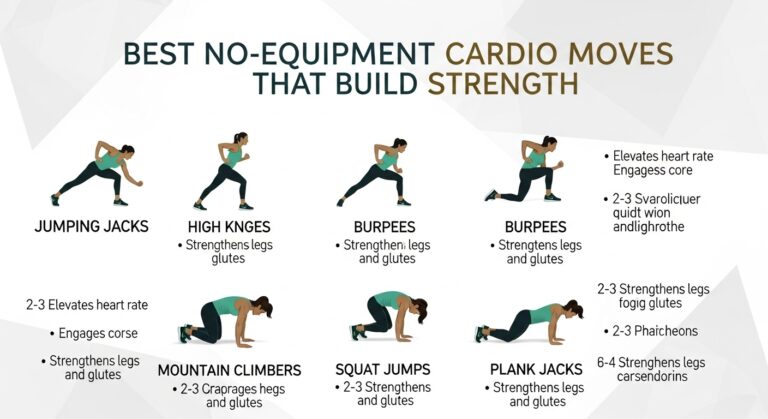
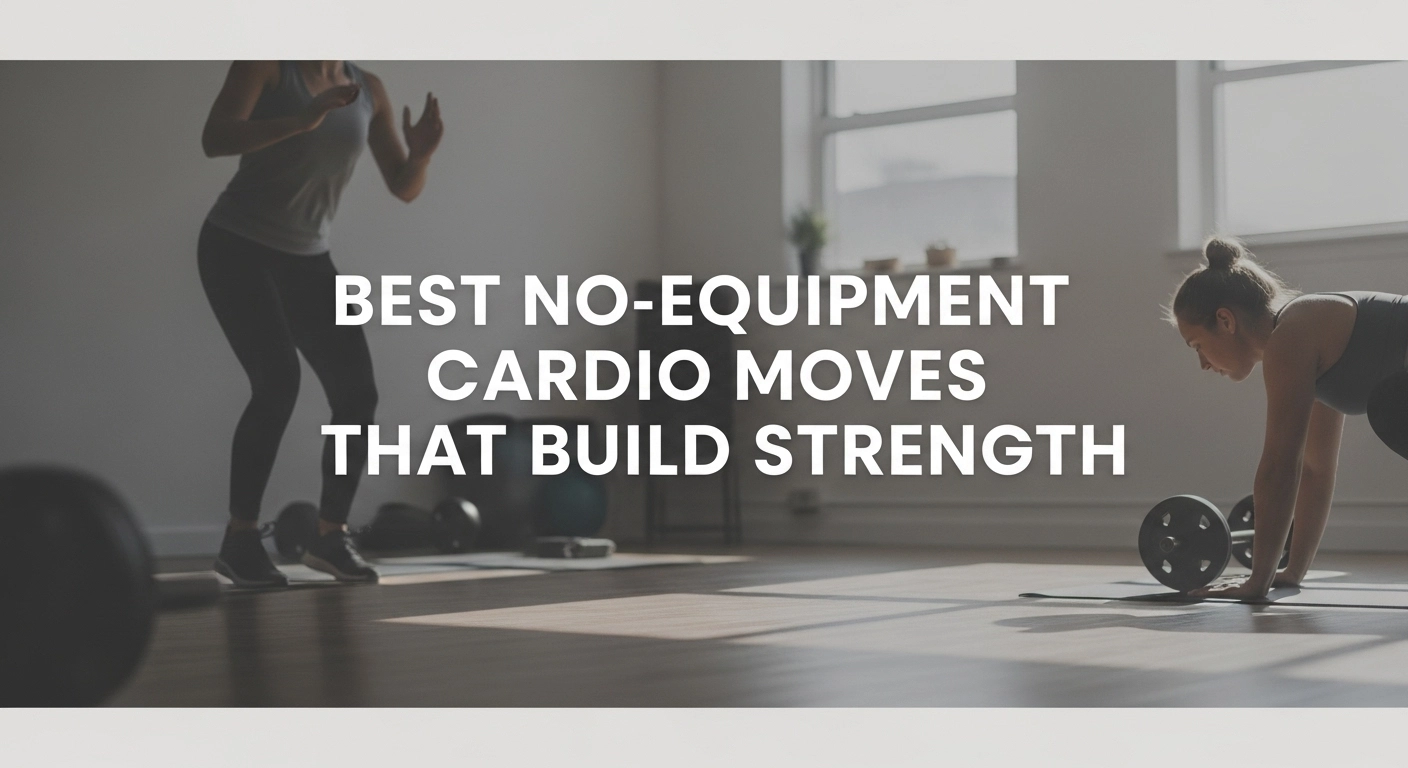
The best no-equipment cardio moves that build strength are multi-joint bodyweight exercises—burpees, jump squats, mountain climbers, plank-to-push-up, and skaters—that combine high metabolic demand with muscular loading. These moves raise heart rate, recruit large muscle groups and improve power, endurance, and functional strength when done as short intervals or circuits.
Best No-Equipment Cardio Moves That Build Strength
Multi-joint, high-intensity bodyweight exercises recruit several muscle groups simultaneously, increasing metabolic demand while producing meaningful mechanical tension on muscles. Interval-style bodyweight training improves aerobic capacity and conditioning in short timeframes, and specific full-body moves such as burpees have been used as practical tests of strength endurance.
The moves (what they target and quick cues)
- Burpee
Primary targets: quads, glutes, chest, shoulders, core.
Why it builds strength: combines squat, plank/push-up and jump—loads lower and upper body while taxing cardio.
Cues: soft knee landing, chest near floor on push-up, land quietly. Low-impact option: step back and step up (no jump). - Jump Squat (or Bodyweight Squat with Tempo)
Primary targets: quads, glutes, hamstrings.
Why it builds strength: plyometric force improves power; slow eccentrics increase time under tension.
Cues: sit back into hips, drive through heels, control the descent. Progression: pause or add single-leg pulses. - Mountain Climbers
Primary targets: core, hip flexors, shoulders.
Why it builds strength: dynamic core stabilization under load plus repeated hip flexion builds muscular endurance.
Cues: keep hips low, tight core; slow for more strength focus, fast for cardio emphasis. - Plank-to-Push-Up (shoulder taps, alternating)
Primary targets: chest, triceps, shoulders, core.
Why it builds strength: trains anti-rotation, pressing strength, and scapular control under fatigue.
Cues: square hips, press through palms, avoid rotating torso. - Skater/Side-to-Side Bounds
Primary targets: glute med, quads, adductors, core.
Why it builds strength: lateral plyometrics strengthen hip stabilizers and single-leg control (important for functional strength).
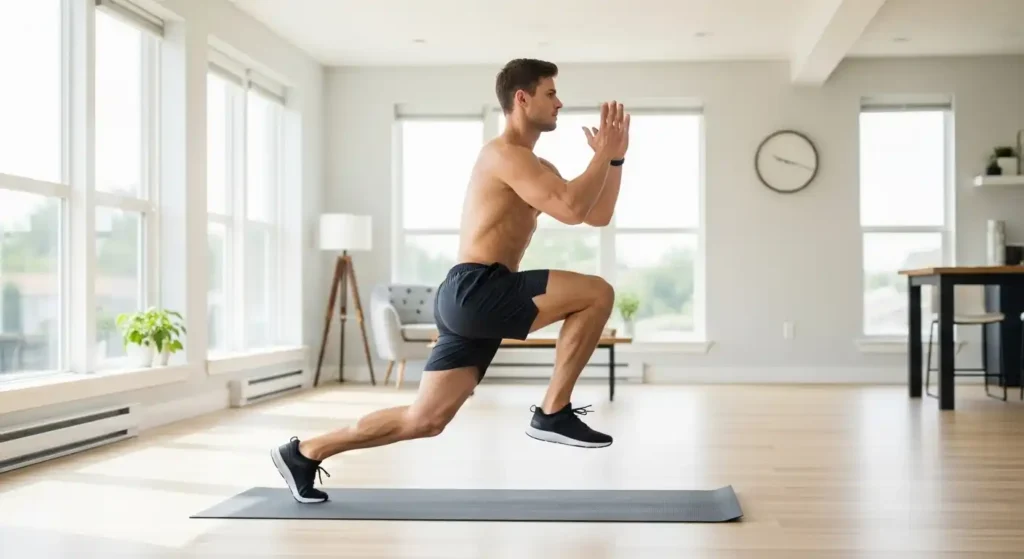
Cues: land softly on bent knee, drive through standing leg. Low-impact option: lateral step with reach. - Alternating Reverse Lunge + Knee Drive
Primary targets: quads, glutes, hamstrings, core.
Why it builds strength: unilateral load builds leg strength and balance; adding knee drive increases power and cardio.
Cues: long step back, upright torso, drive knee up with control. - Broad Step or Tuck Jump (advanced)
Primary targets: glutes, quads, calves, core.
Why it builds strength: explosive triple-extension trains power and fast-twitch muscle fibers.
Cues: land soft, control hips; substitute with high knee run or step-up if joints are sensitive.
How to use the moves: sample circuits and timing
Simple time-based circuit for strength + cardio:
- Work 40s, rest 20s, move to next exercise.
- Choose 5 moves, complete one round (5 min), repeat 2–3 rounds depending on fitness (15–20 minutes total).
Example 15-minute circuit:
- Burpees 40/20
- Jump Squats 40/20
- Mountain Climbers 40/20
- Plank-to-Push-Up 40/20
- Reverse Lunge + Knee Drive 40/20
Repeat once (total ~15 minutes including brief transitions).
Beginner modifications:
- Reduce to 30/30, use low-impact versions (step-back burpee, step jacks, chair-supported lunges), and focus on clean movement.
Advanced variations:
- Shorten rest to 10–15s, add tempo changes (3s down on squats), or add a single-leg progression for more strength stimulus.
Data-driven section: METs and calorie estimates (how to track effort)
The 2024 Compendium of Physical Activities groups vigorous HIIT-style bodyweight work (burpees, mountain climbers, squat jumps, Tabata) at roughly MET 11, while moderate interval conditioning sits around MET 7 depending on pace and intensity. Use the standard formula to estimate calories:
kcal/min = (MET × 3.5 × weight_kg) ÷ 200
Example for a 155 lb person (155 × 0.45359237 = 70.3068 kg)
- MET 7: kcal/min = (7 × 3.5 × 70.3068) ÷ 200 = 8.61 kcal/min → ~86 kcal per 10 minutes, ~172 kcal per 20 minutes.
- MET 11: kcal/min = (11 × 3.5 × 70.3068) ÷ 200 = 13.53 kcal/min → ~135 kcal per 10 minutes, ~271 kcal per 20 minutes.
These MET categories and values come from the Compendium and published activity tables; individual burn depends on exact intensity, rest, and body composition
Practical tracking note: use Rate of Perceived Exertion (RPE) or a heart-rate zone instead of exact calorie counts for better session control.
Progressions that increase strength carryover
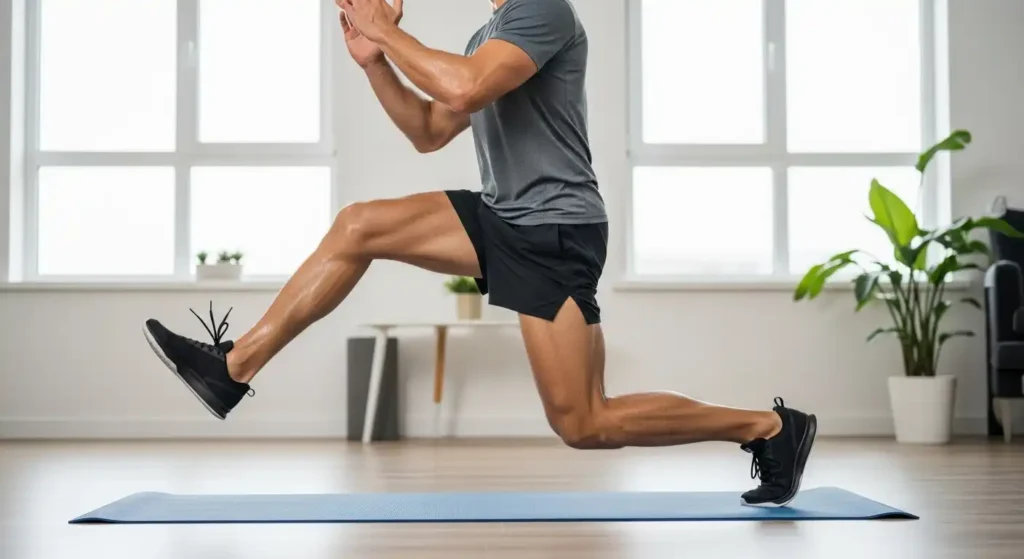
- Increase time under tension: slow eccentrics (3–5s) on squats and lunges.
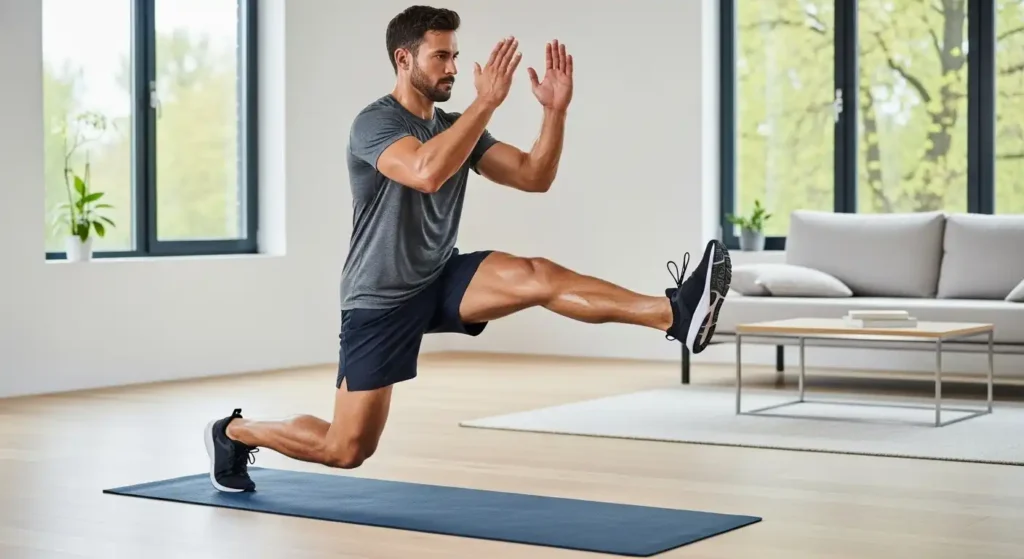
- Add unilateral emphasis: single-leg jump squat, Bulgarian split-squat pulses.
- Increase density: reduce rest, keep the same or more reps in less time.
- Add isometric holds between reps (e.g., 2–3s pause at the bottom of a squat).
These strategies raise mechanical tension and improve strength even without external loads.
Common mistakes and quick corrections
- Mistake: prioritising speed over form. Correction: slow down, limit range until form is clean.
- Mistake: poor landing technique on jumps. Correction: land softly, hips back, knees tracking toes.
- Mistake: ignoring unilateral work. Correction: add single-leg moves to fix asymmetries.
- Mistake: no warm-up. Correction: 60–90s dynamic warm-up (march, arm circles, hip hinges).
Quick comparison table
| Move | Best for | Strength carryover | Low-impact option |
|---|---|---|---|
| Burpee | Full-body power/endurance | High (multi-joint load) | Step-back burpee (no jump) |
| Jump squat | Lower-body power | High (plyometric load) | Tempo squat (slow) |
| Mountain climber | Core endurance | Medium (core under load) | Slow plank knee-ins |
| Plank-to-push-up | Upper-body + core | High (anti-rotation + pressing) | Incline plank taps |
| Skater | Lateral strength | Medium-High (glute med focus) | Lateral step with reach |
Safety and programming notes
- Check with a clinician for cardiac issues or uncontrolled blood pressure before high-intensity work.
- Use shoes and softer surfaces for high-impact moves to reduce joint stress.
- Start with lower volume and build to 2–4 sessions weekly depending on recovery. Evidence shows interval bodyweight training improves VO2peak and conditioning when performed consistently.