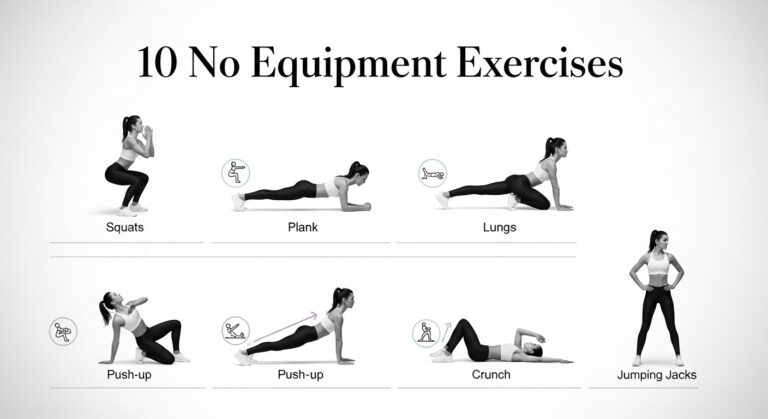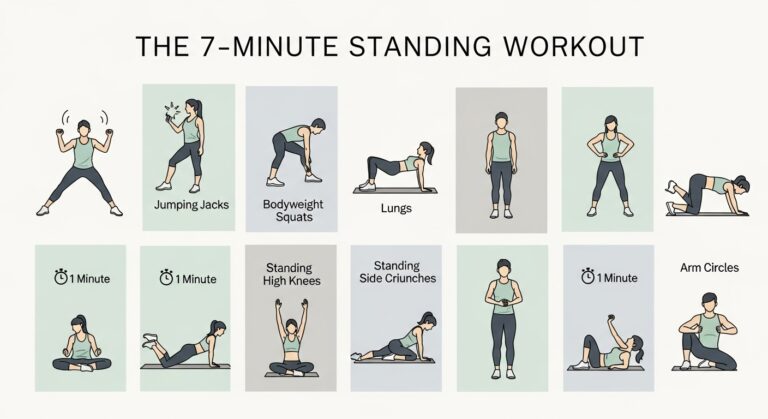

The 5-Minute Fat-Burning Cardio Blast is a quick, high-energy workout designed to raise your heart rate, torch calories, and boost metabolism in minimal time. Perfect for busy schedules, it delivers a powerful cardio session using only body-weight moves—no equipment needed
Why They Work for Fat Loss
| Mechanism | Explanation | Supporting Point |
|---|---|---|
| High calorie burn | Continuous movement with short rest raises total energy use. | Circuit training is proven for weight loss (NerdFitness) |
| Elevated metabolism (EPOC) | The body continues burning calories after training. | Fitbod.me |
| Muscle preservation | Strength-based cardio circuits help maintain lean tissue. | Fitbod.me |
| Time efficiency | High output in short sessions suits busy schedules. | NerdFitness |

How to Design an Effective Fat-Burning Circuit
Basic Structure:
- Warm up 5–10 minutes (light cardio and dynamic stretches).
- Pick 3–8 full-body or cardio-strength moves.
- Perform each for 30–60 seconds with 10–30 seconds rest.
- Complete all stations, rest 1–2 minutes, then repeat 2–4 rounds.
- Cool down 5–10 minutes with gentle movement and stretching.
Sample Intermediate Circuit:
| Station | Time | Notes |
|———|——|——-|
| Jump rope | 45 sec | Quick tempo |
| Bodyweight squats | 45 sec | Controlled form |
| Mountain climbers | 45 sec | Core tight |
| Push-ups | 45 sec | Modify as needed |
| High knees | 45 sec | Max effort |
| Plank hold | 30 sec | Breathe steady |
Rest 60 seconds and repeat 3 rounds.
Progressions: Increase time or intensity, reduce rest, add resistance, or use HIIT timing (20 sec on / 10 sec off). Opt for low-impact alternatives like cycling or step-ups if needed.
Key Concepts to Understand
A. Intensity and Heart Rate: Aim for 70–90 % of max heart rate for best results. Avoid relying on the “fat-burning zone” shown on machines—it’s often inaccurate.
B. Frequency and Duration: Perform 3–5 sessions weekly, 15–30 minutes each. Short, intense circuits outperform longer low-effort workouts.
C. Integration with Strength and Nutrition: Combine with resistance training to maintain lean mass. Effective fat loss also requires proper nutrition and calorie control.
D. Safety and Technique: Always warm up, choose exercises suited to your level, maintain form under fatigue, and allow adequate recovery and hydration.
Sample Circuits by Fitness Level
| Level | Format | Focus |
|---|---|---|
| Beginner | 4 moves, 30 sec work / 30 sec rest, 2 rounds | Low-impact, build form |
| Intermediate | 6 moves, 45 sec work / 15 sec rest, 3 rounds | Cardio + strength mix |
| Advanced | 8 moves, 60 sec work / 10 sec rest, 4 rounds | Weighted or explosive exercises |
Here’s a refined, concise version of unique, value-adding sections for your Fat-Burning Cardio Circuits article — formatted with bullets, short paragraphs, data, and scannable structure.

Data Snapshot: Real Calorie Burn Comparison
Fat-burning circuits outperform traditional cardio in calorie output and metabolic impact.
Average Calories Burned (30 Minutes, 155 lb person):
| Workout Type | Calories Burned | Intensity Level |
|---|---|---|
| Fat-Burning Circuit | 350–450 | High |
| Running (5 mph) | 300 | Moderate |
| Cycling (Moderate Pace) | 260 | Moderate |
| Walking (Fast Pace) | 175 | Low |
| Fact: Circuit-style cardio can raise post-exercise metabolism for up to 14 hours (ACE Research). |
Expert Tips: MAXIMISE Every Round
Trainer-style insights give readers quick, actionable improvements.
- “Tighten transitions.” Shaving 15 seconds of rest per move can raise total calorie burn by 8–12%.
- “Mix resistance with cardio.” Adding 2–3 strength moves helps maintain lean mass while cutting fat.
- “Time your circuits.” 20–25 minutes at 70–85% max effort gives optimal fat-burning efficiency.
Fact: Strength-cardio hybrids increase lean muscle retention by up to 20% compared to cardio-only routines
- “Time your circuits.” 20–25 minutes at 70–85% max effort gives optimal fat-burning efficiency.
Intensity Self-Check: Are You Working Hard Enough?
Use this quick checklist to measure effective training intensity (RPE scale 1–10).
✅ Breathing hard but can speak short sentences (RPE 7–8)
✅ Noticeable sweating within first 5 minutes
✅ Struggle to maintain pace during final round
✅ Heart rate between 70–90% of your estimated max
If fewer than 2 boxes are checked, increase pace or reduce rest.
Pro Tip: The “talk test” is a reliable gauge — if you can sing, you’re going too easy.
Tracking Progress and Avoiding Plateaus
Track heart rate, perceived exertion, and reps per station. Increase difficulty once the workout feels easy by adding resistance or reducing rest. Refresh exercises every 4–6 weeks to prevent adaptation. Support progress with recovery, nutrition, and consistency.

Takeaway
Fat-burning cardio circuits are a powerful, time-efficient method to boost calorie burn and improve conditioning. With consistent effort and structured intensity, they help busy people achieve leaner, stronger bodies in less time.