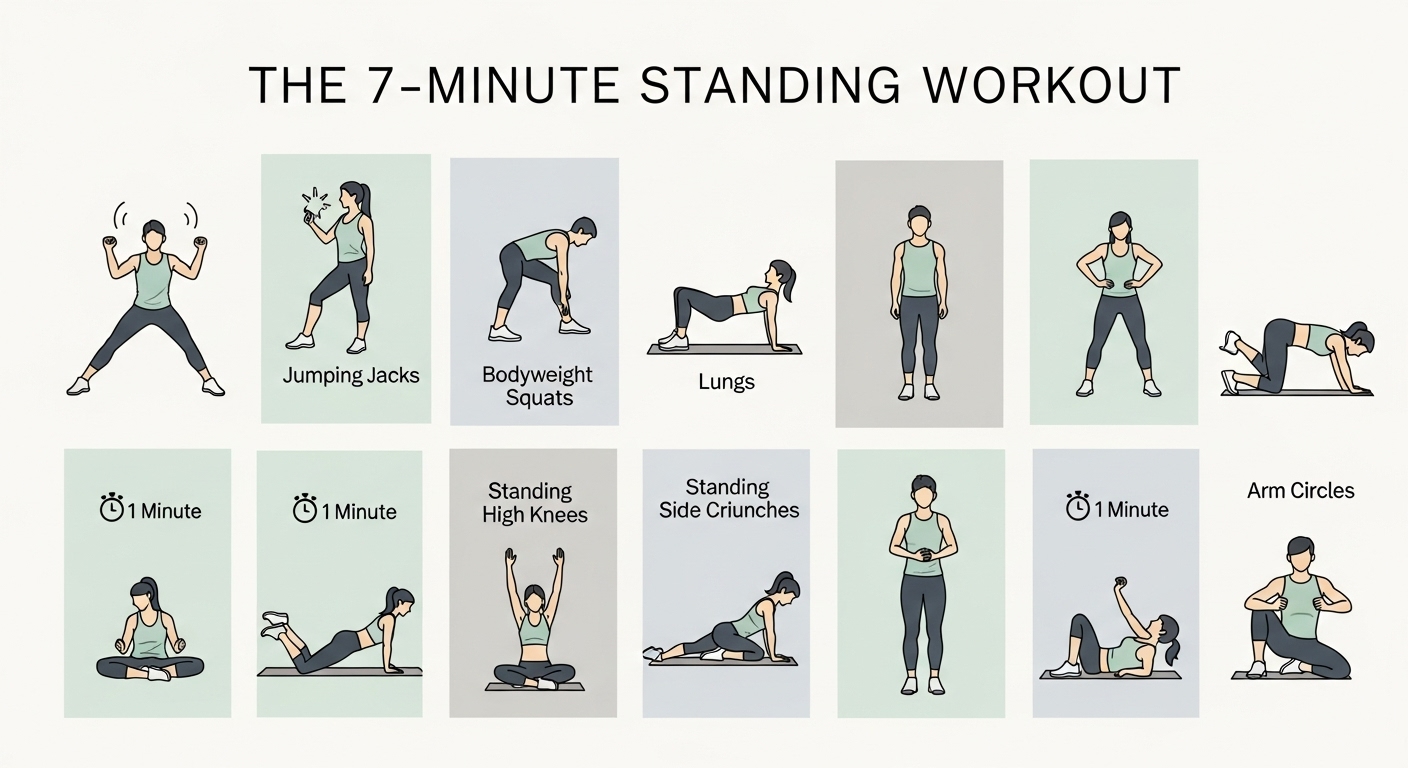
A Recovery Workout focuses on restoring muscle function, improving flexibility, and reducing soreness after intense sessions. It blends gentle mobility, stretching, and breathing techniques to help your body bounce back faster and maintain consistent training progress.

| Body weight (lb) | Moderate effort (approx kcal) | Vigorous effort (approx kcal) |
|---|---|---|
| 125 | 31 kcal | 49 kcal |
| 155 | 39 kcal | 60 kcal |
| 185 | 46 kcal | 72 kcal |
Benefits of a standing routine
- Improves posture and circulation without a mat or floor exercises.
- Strengthens lower body, core, and shoulders with low-impact options.
- Fits short breaks at work, travel, or tight schedules.
- Reduces stiffness from prolonged sitting and supports daily mobility.
- Easy to scale from gentle movement to vigorous interval work.
How to use this routine in a weekly plan
🗓️ Weekly Plan Example
| Day | Focus | Routine Notes |
|---|---|---|
| Monday | Core Activation | Use the 7-minute standing workout to wake up your abs and improve posture. Pair with light walking or stretching. |
| Tuesday | Cardio & Balance | Add a brisk walk or 10 minutes of jump-free cardio after the standing workout. |
| Wednesday | Active Recovery | Do only the standing workout at low intensity. Focus on controlled breathing and form. |
| Thursday | Strength Mix | Combine the standing workout with resistance bands or bodyweight moves (like squats and lunges). |
| Friday | Energy Boost | Use the routine as a mid-day pick-me-up. Add upbeat music to keep energy high. |
| Saturday | Full-Body Flow | Stack the 7-minute standing workout twice for a 14-minute challenge. |
| Sunday | Recovery & Reset | Gentle version of the workout followed by light stretching or mobility flow. |

- Maintenance: 3 sessions per week, paired with mobility or walking on alternate days.
- Build fitness: 4–5 sessions per week, gradually increase work duration or add a second round after two weeks.
- Recovery week: perform 2 easy sessions with longer rests and focus on mobility.
The 7-Minute Standing Workout Routine
Format: 40 seconds work, 20 seconds rest per move. Total time seven minutes. Use controlled tempo and steady breathing.
- Standing march with arm swings
- Lift knees comfortably, swing arms to warm up shoulders and increase heart rate.
- Cue: tall chest, engage core, soft landing.
- Squat to overhead reach (bodyweight)
- Sit back into hips, rise and reach arms overhead.
- Cue: heels grounded, knees tracking toes, chest up.
- Side leg lift (alternating)
- Lift leg to the side with control to work hips and outer thighs.
- Cue: keep torso upright, avoid leaning away.
- Standing alternating knee-to-elbow (standing crunch)
- Bring knee toward the same-side elbow or opposite elbow for rotation.
- Cue: controlled motion, brace core, avoid pulling neck.
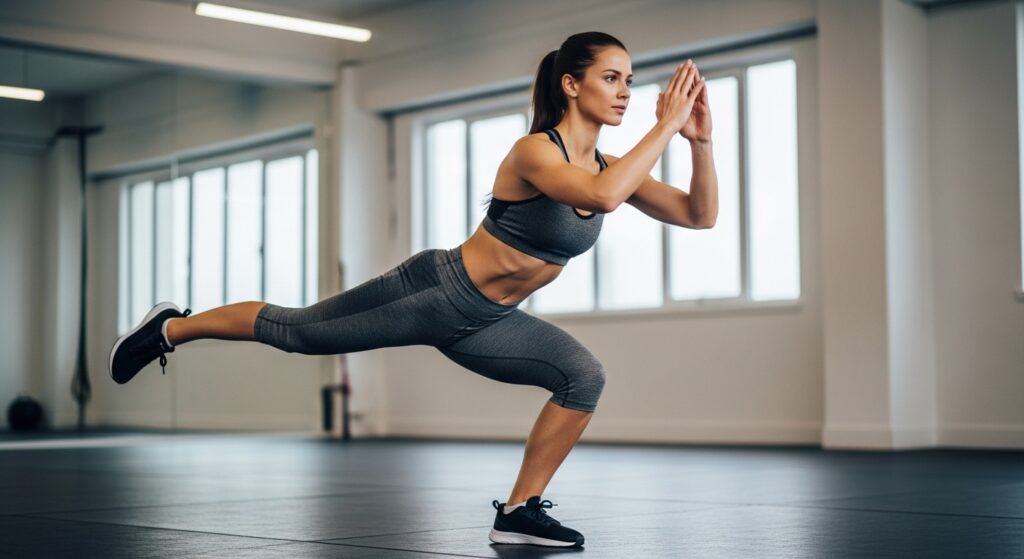
- Reverse lunge with reach (alternating legs)
- Step back into a lunge and reach arms overhead as you return.
- Cue: front knee soft, long step, tall spine.
- Arm circles with light pulses
- Small forward circles then reverse, add 2–3 small pulses mid-set.
- Cue: keep arms at shoulder height, move from shoulders not neck.
- Standing side bend with core engagement
- Hands behind head or at temples, bend slowly to each side.
- Cue: lead with ribs, avoid rotating forward, feel obliques.
Warm-up (60–90 seconds)
- March in place 20 seconds
- Hip circles 10 each direction
- Arm circles 10 forward, 10 back
- Bodyweight half-squats 10 reps
Cooldown (60 seconds)
- Deep breaths and shoulder rolls 20 seconds
- Chest opener (hands clasped behind) 20 seconds
- Gentle side stretch each side 10–15 seconds
Modifications and progressions
- Beginner: 30 seconds work, 30 seconds rest, reduce range of motion, hold onto chair for balance.
- Intermediate: follow 40/20 format as written. Add a second 7-minute set if you want more volume.
- Advanced: 45/15 or perform explosive versions (jump squats, quick alternating knee drives).
- Specific focuses: swap moves to emphasize balance (single-leg stands), cardio (high knees), or strength (slow tempo squats).
Estimated calorie burn (data-driven guide)
Calories depend on bodyweight and intensity. Estimates use a MET-based calculation for a 7-minute session; treat them as approximations.
Note: These are rough estimates. Actual burn varies with age, sex, fitness, exact movement intensity, and individual metabolism. Use perceived exertion and heart-rate tracking for more precise feedback.
Common mistakes and how to avoid them
- Rushing through moves: prioritize control and full range over speed.
- Collapsing chest in squats: keep chest lifted and core engaged.
- Short steps in lunges: use a long enough stride to protect the knee.
- Ignoring breath: exhale on exertion to maintain effort and rhythm.
- Skipping warm-up: even 60 seconds reduces injury risk and improves performance.
Misconceptions about standing workouts
- Myth: standing workouts are not intense enough. Reality: with the right tempo and minimal rest, standing circuits deliver meaningful strength and cardio stimulus.
- Myth: you can spot-reduce fat with standing core moves. Reality: core moves build stability and muscle but overall fat loss needs total energy balance.